Share this
by Wietse Mol
Many EPM projects start with a touch of magical thinking: the idea that if the plan is detailed enough, the implementation will follow it neatly, or that if the team moves fast enough, complexity will somehow resolve itself along the way. Most organizations pick a side: waterfall or agile. Waterfall gives you a solid, upfront design, but locks you into a rigid plan that breaks the moment reality shifts. Agile gives you speed and flexibility but skips the upfront thinking a complex platform needs. Neither approach on its own is enough, so we combine them. We call this approach "Beyond the waterfall."

Agile, waterfall, or the best of both?
First, you spend a good deal of time on getting the high-level functional requirements clear of the system as a whole. Then you design a structure that can hold all those requirements, but it does not need to be a fully detailed design. That would bring back the rigidity of the waterfall. What is needed is that for every sub block, you identify what information you need to start building and who needs to deliver that information. This way, you build towards a bigger whole, can plan deadlines and delivery, prevent re-work, but at the same time keep the flexibility needed to adapt when you run into a snag.
In the next phase, the individual build sprints, you have a solid basis to start from. You only start that sprint when you have collected all necessary information.
That combination is what "Beyond the waterfall" means: a solid plan and fundament, built out incrementally, run by the team that knows your EPM platform best.
Implementation: set your points first
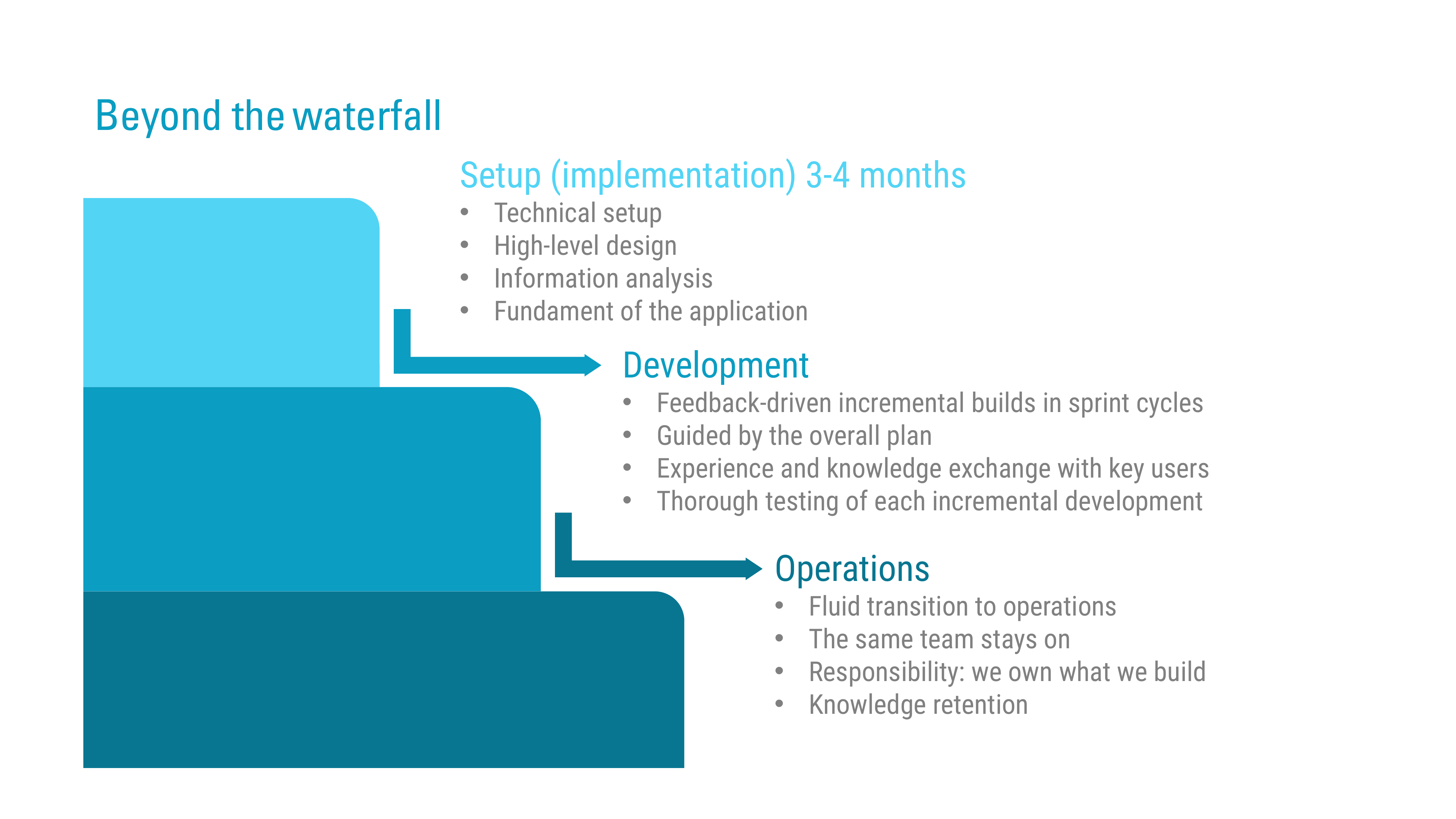
Setup takes 3 to 4 months and lays the fundament for everything that follows. The deliverable of the setup is a working, deployed, operational part of the application, such as a consolidation or planning model. This ensures you get a usable component in the hands of the organization fast, show what it delivers, and build user acceptance from there. Most projects reach that first tangible milestone within 3 months.
The team works out the technical setup, the high-over design, and the information analysis the platform needs. That combination becomes the fundament of the application, the base every module builds on later.
Think of it as sculpting. Michelangelo is famous for freeing figures straight from raw marble, guided by instinct alone. Some fully agile projects almost feel the same way, starting at an arbitrary point, and taking it from there seeing where we end up. But most of us aren't Michelangelo. We need markers in the stone before the first strike of the chisel, so we know the proportions and the space we're working within, even if the final shape still takes form as we go. That's what setup does: it creates the fundament.
Development: build in increments, not all at once
Once the fundament stands, development turns the design into a working platform. We do so one module at a time, in feedback-driven sprints that follow the overall plan from the setup phase. Each increment fits the bigger picture instead of drifting from it. The team and the users exchange ideas and information as they build and test every increment thoroughly before it ships.
That incremental rhythm pays off fast when you pair it with AI. Migrate your consolidation data straight from the legacy application, or use AI in the requirement phase to quickly determine what the application needs to do.
DevOps: the same team owns what it builds
Development moves into operations without a handover. No new team steps in, and no knowledge walks out the door. The people who built the platform run it, because they own what they built. That ownership keeps the platform stable, and when key users move on, as they eventually do, the knowledge stays with the team, not with the person who left.
Why we developed our ‘Beyond the waterfall’ approach
We built this integrated, incremental approach on what we see in practice, day in and day out. It's not a theoretical model, but a real-life approach based on experience. No magical thinking or unicorns chasing waterfalls, but a method that holds up when the plan meets reality.
Setup sets the fundament, development builds on it in increments, and that same knowledge is kept in-house during operations. Because that's what actually works on real EPM platforms, with real teams: tangible results in 3 months.
Discover the experiences of ASML, Viking, and other organizations
Curious how this works in practice? Join us at Future Foundry, our annual event, where ASML, Viking, and other organizations share their experiences during the Client Spotlight breakout sessions.
Share this
Join the Future Foundry: The next edition