Share this
There's more than one way to move data out of a Performance Management system and into the reports that drive decisions. cpmVision's approach connects OneStream and CCH Tagetik directly to Power BI. We spoke with Reporting Director Casper Plantinga and Project Delivery & Success Manager Paul Obbink ahead of their breakout session at Future Foundry 2026, to find out what that connection changes for finance and ESG teams.
1. How have you seen the field of EPM (Performance Management) change in recent years
Casper: The relationship between finance and data has shifted. The C-suite and the layers below want direct access to the numbers and make decisions faster, which means the data itself has become more central to how those decisions get made. That's driving a broader move to unlock data straight from EPM systems like OneStream and CCH Tagetik through Power BI, so it reaches the CFO or CEO directly, instead of working its way there through a chain of PowerPoints someone had to build first.
2. Where does AI fit into that picture?
Casper: Same principle, different tool. Once the data sits close to the decision-maker, a CFO can open a dashboard, pull together the figures that matter, and get a summary without pulling the finance team into it. And it's not a black box: every summary can be validated by clicking through to the underlying figures or restructured by simply asking for it differently.
The more interesting part is what AI reads beyond the numbers. It picks up the commentary that local teams and business units add to their reports, so a summary reflects context, not just a month-end snapshot of a P&L. It also flags deviations and anomalies automatically, and because it understands how KPIs relate to each other, it can connect a change in cost or revenue directly to its effect on EBITDA. That's the kind of explanation finance teams currently write out by hand, often more than once.
3. What does that mean for an organization, beyond the dashboard itself?
Casper: It tends to clean things up further down the chain. When leadership starts working directly with a dataset, the data underneath it has to hold up, which pushes teams to keep the source systems accurate instead of patching things together in a spreadsheet before a board meeting. One CFO put it plainly: he didn't want to see anything in his board meeting except reports where the data was already structured.
Organizations also keep changing, and that has to be reflected in the systems in real time. The faster that happens, the faster the analysis that follows it.
4. Beyond AI, what other technology shifts matter here?
Paul: The bigger conversation is often about structure, not technology. In finance, there are plenty of standards for what you need to report, but far fewer for how it should look. That's what the International Business Communication Standards, IBCS, address. It's a clear framework, still underused, but the reports we build around it read faster: no decorative color-coding, just what deviates from the plan and needs a decision.
Casper: That same discipline runs through the infrastructure underneath it. With Microsoft’s One Lake concept, data no longer needs to move between systems to be used. It stays where it is, and different data warehouses can read it without duplicating it. That matters because the data coming out of OneStream and CCH Tagetik is well governed. It's a critical business process, so it's usually the first place a change in the organization shows up. We reuse those same hierarchies for reporting elsewhere, instead of rebuilding structures that already exist.
5. What does this change for the people doing the work?
Paul: EPM systems were built to speed up how data gets collected and processed. That's the first step, and most organizations have made it. What's often missing is the second step: automating the reporting that sits on top of that data. You can process your data faster and still lose the time at the end, writing the same report by hand. That shift shows up in how people spend their day. Less time goes into copying and pasting between systems, and more into work that requires financial judgment.
6. How does this apply to sustainability reporting and planning?
Casper: ESG teams work differently from finance teams, but they want the same thing: to look at their data quickly and analytically. That's easier in Power BI than in a heavier EPM system. The collection process in OneStream and CCH Tagetik is solid, but reporting on top of it is faster in Power BI, so we built templates specifically for ESG reporting and carbon emission reduction planning.
Paul: Another interesting topic is the connection between sustainability planning and realization. Many organizations can report on where they stand, but not many can yet plan toward where they need to be, and that gap matters in ESG. Visualizing trends over several years, not just deviations from a single target, shows whether current planning is converging on the goal. That also means being able to trace which specific actions drove, for example, an emission reduction, down to a business unit or a single calculation, and pairing that with the commentary that explains it. It's the same logic we apply in finance, combining the numbers with the narrative around them, just applied to emissions instead of revenue.
7. What's the biggest misunderstanding you run into?
Paul: That connecting data out of an EPM system is simple. It looks that way at first but getting from raw data to a report that finance can trust takes more financial intelligence than people expect, and that shows up later in maintenance. Building it yourself feels straightforward in month one. The real cost appears the first time something changes and the whole thing needs to be rebuilt. Once that trade-off is clear, the case for buying usually becomes obvious. We've seen organizations reach a genuine finance transformation in six to eight weeks by buying instead of building.
Casper: We also see BI teams that model small pieces of the business separately. That gives you datasets that each answer one question well, but not a single view across the finance function, and something breaks every time they need to reconnect. That's the problem a single, integrated model solves.
8. What do you expect going forward?
Paul: Regulation keeps expanding. IFRS, Solvency II, and ESG reporting requirements all demand more structured data behind it. Finance usually gets asked to solve that first, because structuring data is what finance is good at. AI helps with that, but it's a tool, not the answer. The real work is applying a structure to your data, not just designing one on a slide. Anyone can sketch a good structure. Getting it to hold up in practice is the harder part, and that's the distinction that matters.
9. What's new that people should come see during your session at the Future Foundry, even those who already know cpmVision’s solution?
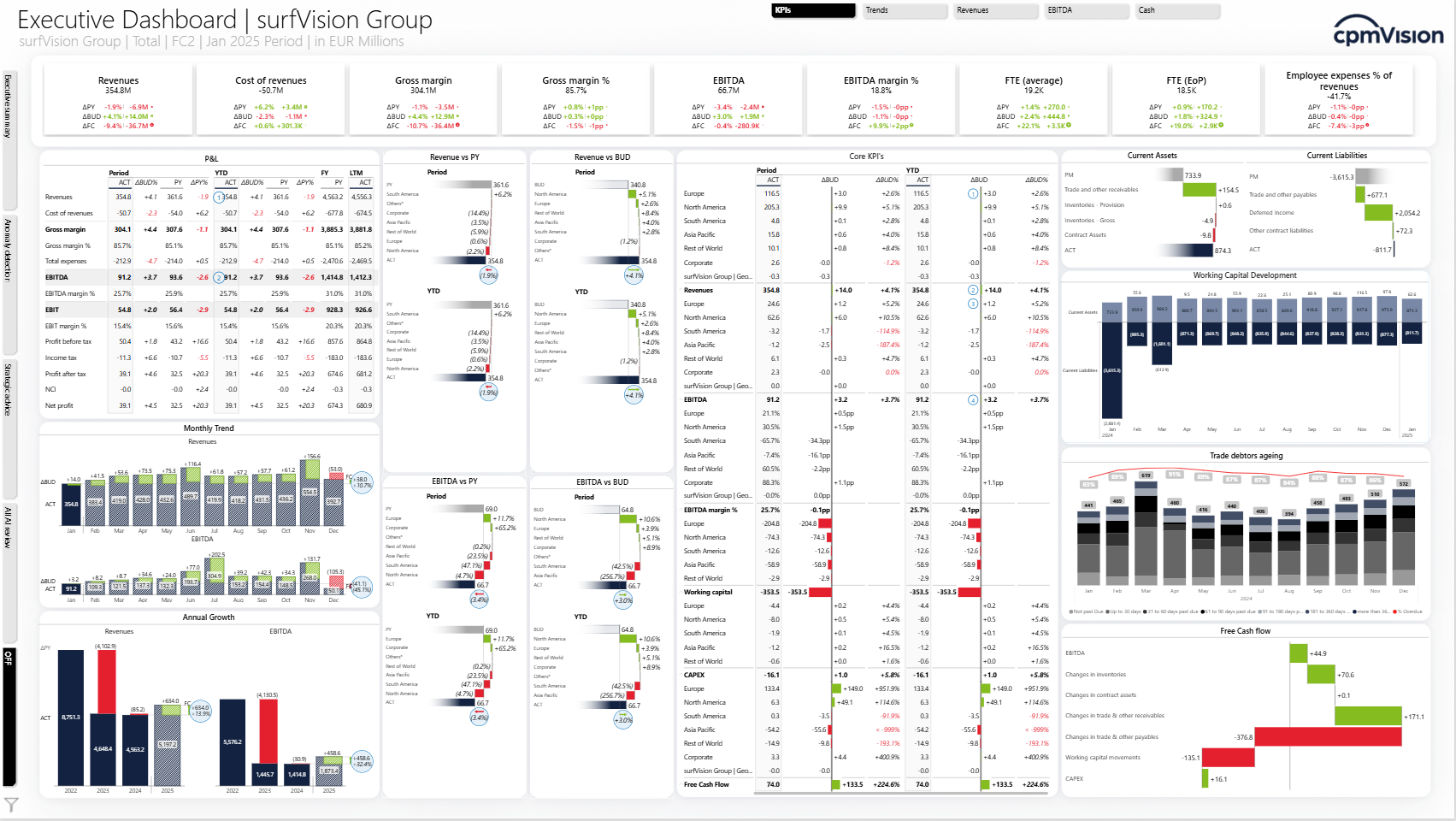
Casper: Two things. The OneStream connection itself is new, so for organizations running OneStream, the session is a chance to see live what it can do. And for organizations already on CCH Tagetik, there's the executive dashboard, now a reusable template that gives a CFO one clear view instead of a stack of reports. Also, we release two to three updates a year, so what's in the demo in September is worth seeing even if you've been to a cpmVision session before.
Curious what the connection between Power BI and OneStream or CCH Tagetik looks like in practice? Join Casper Plantinga and Paul Obbink at Future Foundry 2026, Swap Support’s annual event for professionals in finance, BI, and ESG.
Join us at the Future Foundry
Share this
Join the Future Foundry: The next edition