Share this
The future of performance management doesn’t wait. Tomorrow takes shape in the choices you make today. That’s the idea behind Future Foundry, Swap Support’s annual event for finance, BI, ESG, and digital transformation professionals. At Vuursche Lodge in Baarn, over 100 participants spent the day turning that idea into something concrete: practical answers that create a stronger grip on tomorrow’s challenges.
Turning up the heat
Inspired by craftsmanship, Future Foundry captures the same energy Swap Support brings to its clients: skill, focus, and collaboration, turned into practical progress. Host Gerben van Driel, journalist, presenter, and business economist, kept the day sharp and engaging from the first session to the last.
Wietse Mol, co-founder of Swap Support, deepened the image that gave Future Foundry its name. “A foundry heats metal to shape it, but it never loses its solid core. That’s exactly the balance we create for our clients: constantly evolving and innovating, while providing stability through solving incidents and keeping your systems running.”
Since Swap Support started over 15 years ago, the pace of change has only picked up. Wietse: “What used to be a single implementation project followed by support has grown into a continuous cycle of improvement, turning Swap Support into a strategic partner for our clients.”
Introducing Cognitive Intelligence for Enterprise
His excitement about AI was obvious and aligns with the announcement of a new partnership with Quneu, focusing on Cognitive Intelligence for Enterprise. Wietse: “Cognitive Intelligence (CI) is about different AI agents exchanging information with each other. We want companies to get real value out of their own data, without it ever leaving their walls.”
Keynote Tessa Cramer: becoming future-ready in a fast-changing world
Futurist and professor Tessa Cramer opened with a reminder: when we talk about the future, we usually end up talking about technology. What matters more, she said, is how we deal with not knowing. She advises working with different futures: “The possible future is everything you can imagine. The probable future is the realistic path you’re likely heading toward. The preferable future is the one you want, usually the one captured in your vision or strategy document. Most organizations only look at one of the three, which is exactly the pitfall: thinking in a straight line, instead of learning from other perspectives.”
3 shift skills for an uncertain future
Alongside hard and soft skills, Tessa argued, organizations need shift skills, transformational skills that turn change into progress instead of resistance. Tessa singled out 3, each with a micro experiment you can start today:
-
Bring back awe. Awe is what you feel when you’re part of something bigger than yourself, and it opens the door to things you’re not certain about yet. Tessa: “It matters, because so many people treat AI like an oracle, a stand-in for the sense of wonder we used to find elsewhere.” She had the participants try it live: pick a photo from your phone that sparks something in you and really focus on it. About 15 percent felt an instant mood lift. Most others felt something shift after a moment.
Micro experiment: take a walk outside with your team, put your phone away, or simply appreciate a colleague. Small breaks in routine are enough to bring awe back.
-
Protect your focus. Everyone’s calendar is full of urgent things and leaves too little time for important tasks, like the long-term work that shapes your future. Saying no, Tessa said, is a skill: the better you get at it, the better you get at saying yes to what matters.
Micro experiment: every Monday morning, ask your team one question: what matters most this week?
-
Expect the unexpected. Not every organization needs the same amount of change at the same time. The sweet spot sits somewhere between too much change and not enough, and it’s different for everyone. Recognizing where your organization stands today, and where your people are, is the first step to moving forward together.
Micro experiment: name one uncomfortable topic that deserves more attention at your organization, and put it on the agenda.
Read more about Tessa Cramer’s take on grip, AI, and shaping the future today.
Breakout sessions: EPM, BI, and ESG in practice
In the breakout sessions, clients and partners shared what EPM, BI, and ESG reporting look like in practice, and the role AI increasingly plays.
-
ASML: sales planning transformation with SAC. Yannick Knechten from ASML, Ruben Rombouts, and Edwin van Geest, both from Swap, shared how a modern Sales Planning solution, built in SAP Analytics Cloud (SAC), gave the business more ownership over planning, and an honest look at the challenges along the way. Request the demo about SAC Planning to discover more.
-
BME: closing in under a week with CCH Tagetik. Bas Steltenpool from BME explained how BME cut its close down to under a week, with AI-powered anomaly detection doing some of the heavy lifting. CCH Tagetik’s road map covered what’s already possible, and what’s next in agentic AI. Join us at the Tagetik InTouch in Amsterdam on 27 October 2026.
-
Samskip: OneStream and what’s next with sensible AI. Reinier Baai shared what OneStream brought Samskip, followed by a live demo of OneStream’s AI roadmap: what becomes possible once your platform is in order and AI enters the picture. Request the demo about OneStream to discover more.
-
Viking: 10 years of financial transformation with Oracle. Viking shared its journey from on-premises finance solutions to Oracle Cloud EPM, and how Swap Support was the stable factor during all the upgrades, developments, and team changes. The live demo of Oracle’s roadmap showed what’s next now that AI is entering the picture. Join our Oracle Inspiration Session with Americold on 24 November 2026.
-
Intire and 4CEE: the ESG data supply chain. Intire and 4CEE showed how your organization isn’t just a consumer of supplier data, but increasingly a provider of data to your own customers, and how capturing structured transaction data at the source improves data quality and cuts manual work. Request the demo about Decarbonization planning in SAC to discover more or attend Intire’s events.
-
cpmVision: unlocking EPM data with Power BI. cpmVision demoed how connecting OneStream or CCH Tagetik to Power BI turns EPM data into finance-ready reporting. Request the demo to discover more.
Panel: AI in the workplace, from hype to reality
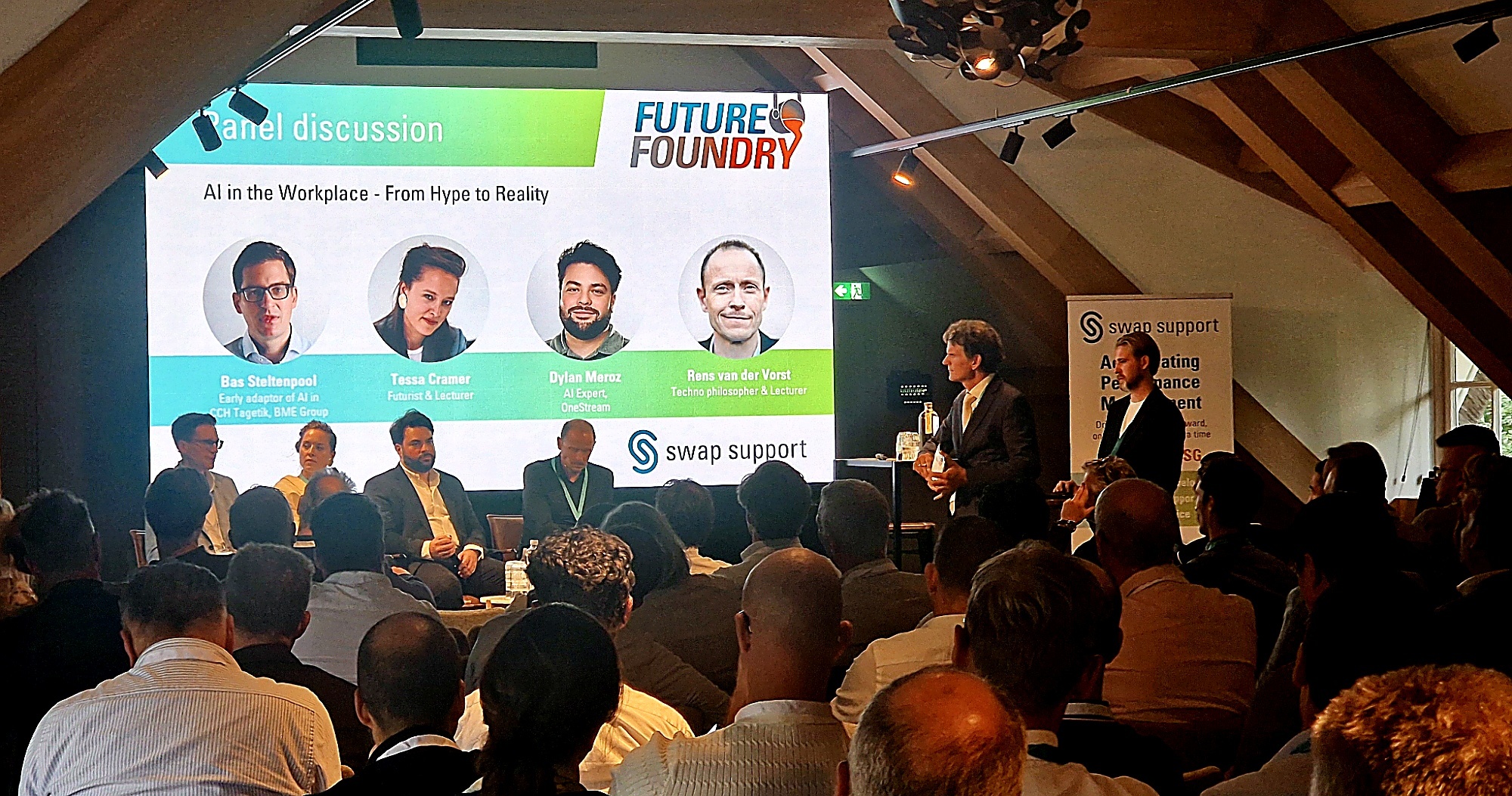
The panel brought together various perspectives: Bas Steltenpool, Group Manager Accounting & Reporting at BME, and Dylan Meroz, AI Expert at OneStream, alongside Tessa Cramer and tech philosopher Rens van der Vorst. Bas is an early AI adopter: BME ran the first global implementation of CCH Tagetik AI agent and recently won an award for it.
That range of views became tangible as soon as the first question was posed: Is the AI hype justified? Bas, Dylan, and Rens agreed without hesitation. Tessa zoomed out: “Hype rises and falls in cycles, and this one is no different.” The panelists disagreed on whether AI adoption is even a choice. Dylan called it inevitable: “You either get onboard or you get left behind.” Rens had the opposite view: “Technology is not a force of nature.”
They diverged about how to start too. Bas believes in learning by doing: “When CCH Tagetik introduced new AI agents, we were keen to test them. Anomaly detection was the perfect way to get comfortable with AI as an organization.” Dylan added that most organizations are further along than they think: “You already have so much data sitting in your EPM systems.” Rens disagreed with these approaches: “Don’t start because ‘you want to do something with AI’. You have to be specific about what you mean.” Tessa's take: “Slow down before you accelerate.”
The biggest misconception, all agreed, isn’t that AI will make people redundant. It’s that you can skip the hard part: talking concretely about what AI means, what you want it to do, and why.
Keynote Rens van der Vorst: release your inner gremlin
Tech philosopher Rens van der Vorst closed the day with a fast-paced, funny, and more than a little unsettling keynote. Technology isn’t the same as progress and isn’t neutral, he argued. Neither is the world it’s building: most of the digital tools shaping our lives were built by the same narrow group of people. His advice: release your inner gremlin. “Sometimes sabotage your own technology, just to rediscover what it means to be human.” Read more about Rens van der Vorst’s take on technology, privacy, and why you need a digital gremlin.
Shaping the future, together
By the end of the day, one thread ran through every keynote, panel, and breakout: technology only moves things forward once people are ready to use it well. The future of performance management isn’t built by technology alone. It’s built by the choices we make using it.
Already looking forward to the next edition of Future Foundry?
Register now, and we’ll keep you posted as the program takes shape.
Share this
Join the Future Foundry: The next edition